Picky
How to calculate your real profit per km as an Uber or Bolt driver
"20 lei for 3 km, that's almost 7 lei per km!" It sounds great until you take out everyone else's share. Here's how to work out what an offer really pays you, in under a minute, with examples in lei and euros.
Step 1: start from the offer price
This is the amount on the offer card. Depending on your country and app, it may already be your share after the platform's commission, or it may be the full fare. Check once in your earnings screen which one your app shows, because it changes the whole calculation.
Step 2: take out the platform's cut
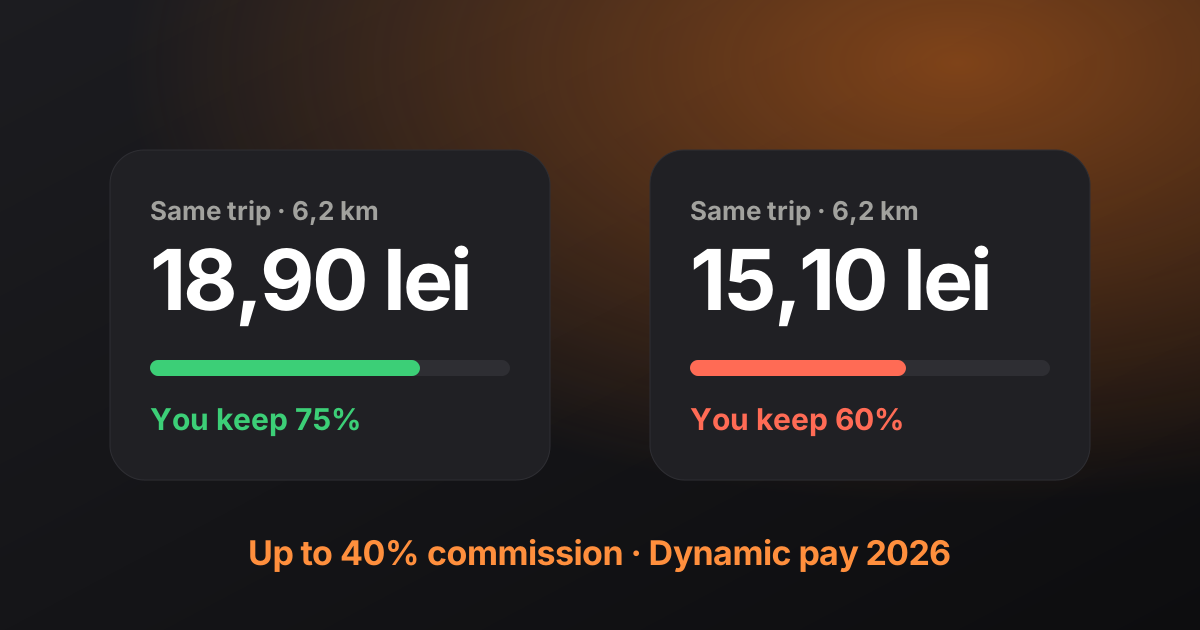
If the offer shows the full fare, subtract the commission. It used to be a steady 20–25% on most apps; with dynamic pay, Uber's commission now varies from trip to trip (see dynamic pay in 2026). Use the average you actually see in your weekly statements.
Step 3: take out your fleet's fee
Many drivers work through a fleet partner who takes a percentage or a weekly rent. If it's a percentage, apply it to what's left after the platform. If it's a fixed weekly rent, divide it by the kilometres you drive in a typical week to get a cost per km.
Step 4: take out fuel and wear
This is the part most drivers forget, because it doesn't leave your account on the day of the trip.
- Fuel or charging per km = price per litre (or kWh) × consumption per km. For example, 7,50 lei/l at 6,5 l/100 km is about 0,49 lei per km.
- Maintenance per km: tyres, brakes, oil, services. Add up a year and divide by the kilometres. For many cars it lands somewhere around 0,10–0,20 lei per km.
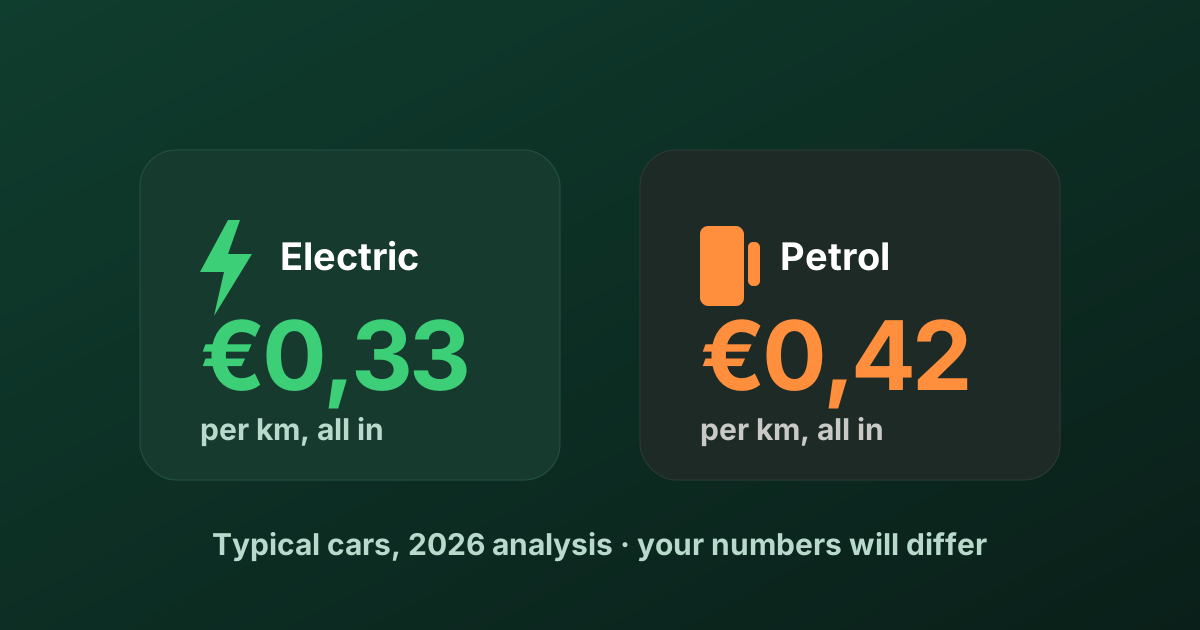
- Depreciation, if you own the car, is often the biggest cost of all. An Irish 2026 analysis of a typical petrol car put the all-in cost at about €0,42 per km, with fuel alone around €0,14.
Important: apply fuel and wear to all the kilometres, including the drive to the pickup. Your engine doesn't know which kilometres were paid.
Step 5: divide by kilometres and by time
What's left is your net profit for the trip. Divide it by the total kilometres (pickup + trip) and by the total time in hours. Those two numbers are what you compare offers on.
Worked example in lei
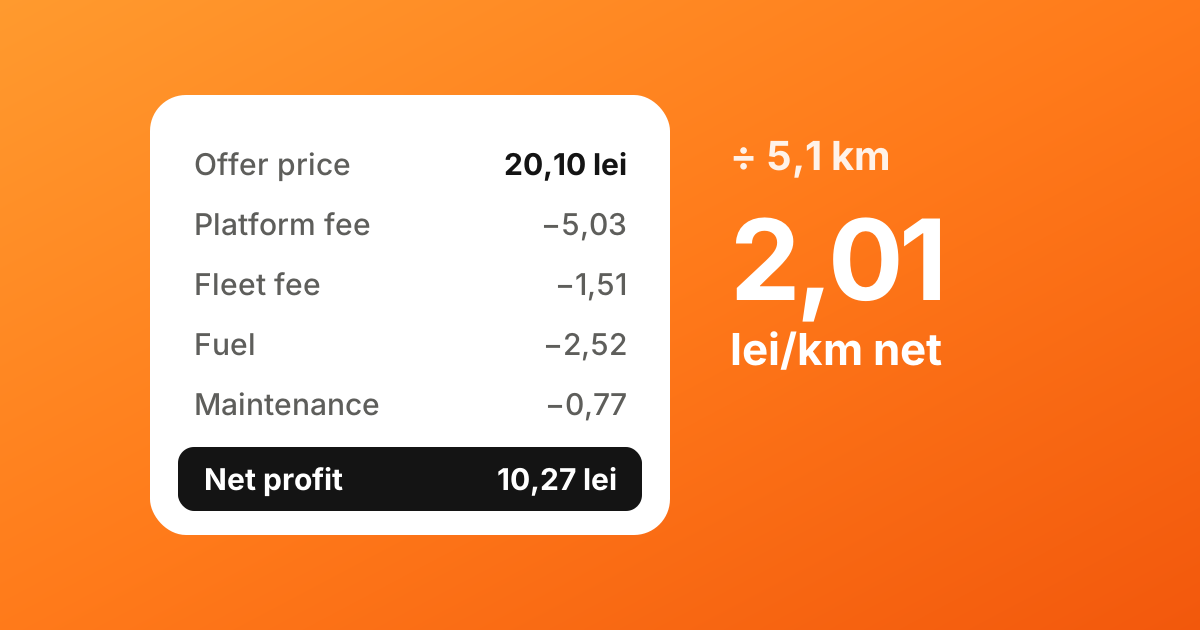
The trip is 2,0 km to the pickup plus 3,1 km with the passenger, 13 minutes in all. So:
- Net per km: 10,27 ÷ 5,1 = 2,01 lei/km
- Net per hour: 10,27 ÷ (13 ÷ 60) = 47 lei/h
That "almost 7 lei per km" offer actually pays about 2 lei per kilometre. Still a good trip for many drivers, but a very different picture.
Worked example in euros
A €12 offer: 1,5 km to the pickup, 6 km with the passenger, 18 minutes in total. Platform fee 25% (€3,00), fuel €0,12 per km (€0,90) and maintenance €0,06 per km (€0,45), no fleet.
- Net profit: 12 − 3,00 − 0,90 − 0,45 = €7,65
- Net per km: 7,65 ÷ 7,5 = €1,02/km
- Net per hour: 7,65 ÷ 0,3 = €25,50/h
Set your minimums
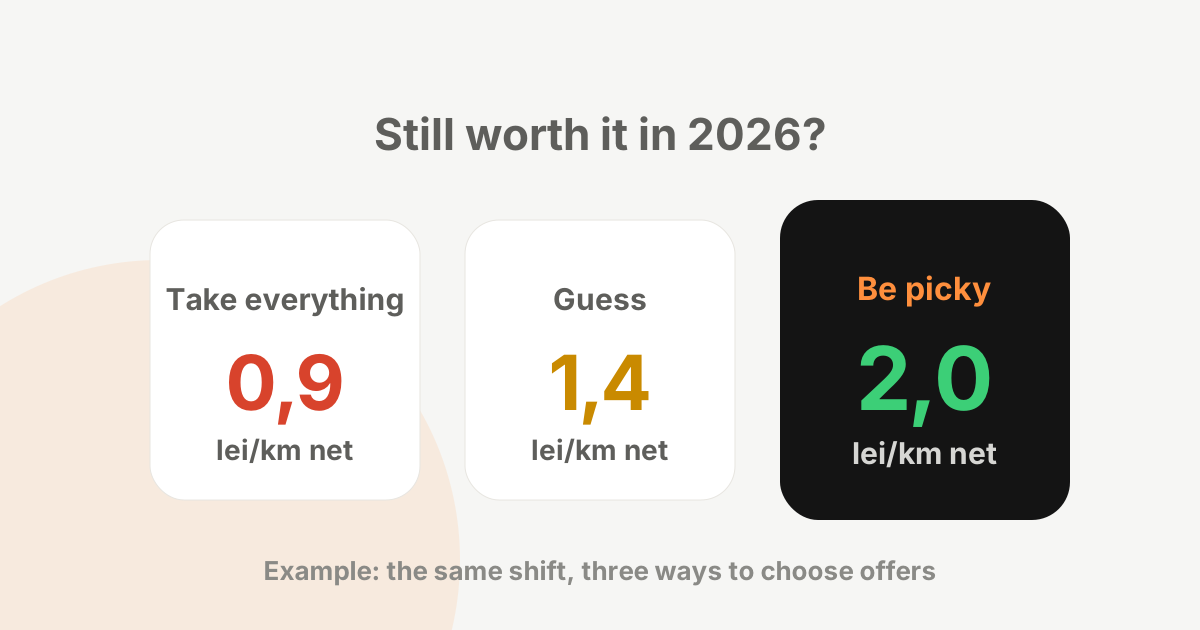
Once you know your numbers, pick two lines: the lowest net per km and the lowest net per hour you'll accept. Many drivers use a lower bar at quiet times and a higher one at rush hour. Anything above both is a clear yes; anything below both is a clear no; the rest is your call.
Common mistakes
- Ignoring the pickup. A 4 km pickup for a 2 km trip doubles your costs.
- Comparing gross per km. The price divided by trip km always looks better than reality.
- Forgetting the fleet. A 10–15% fleet share changes which trips are worth it.
- Only looking at per km. A slow trip through traffic can pay well per km and badly per hour.