Picky
Long pickups: how far is too far for an Uber or Bolt trip?
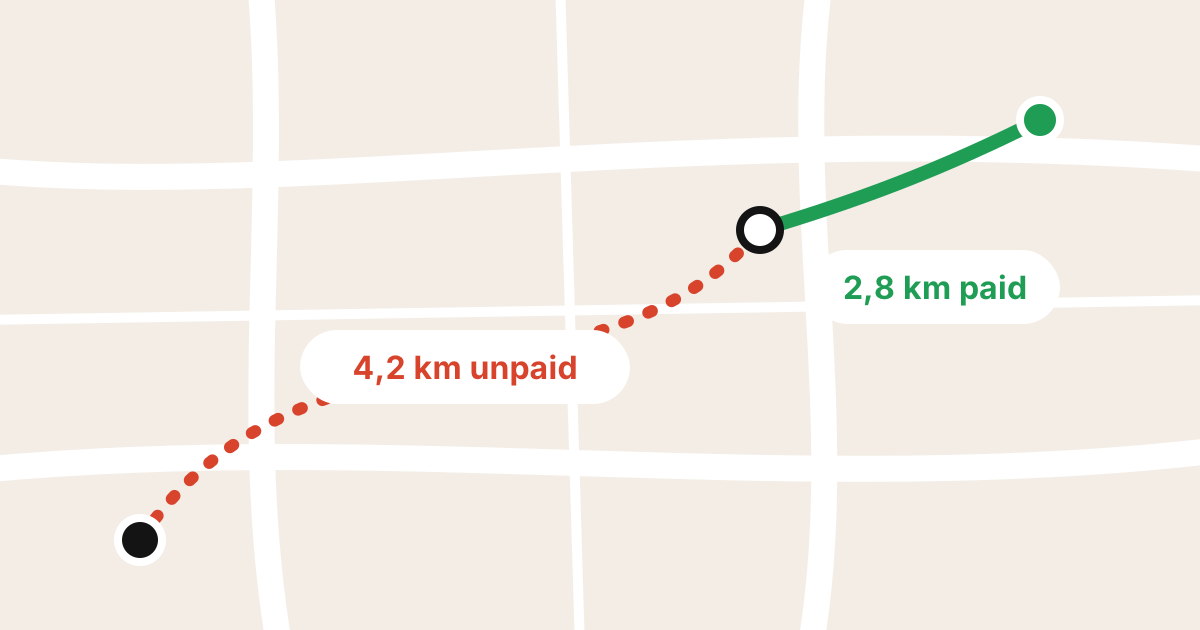
The offer says 3 km. The pickup is 4 km away. You'll drive 7 km for a price set around 3. Long pickups are one of the quietest ways good-looking offers turn into bad ones.
Why pickups matter more than they look
With upfront prices, the pickup distance is usually priced into the offer rather than paid as a separate line, and in most cases you don't see how much of the price is meant for it. Your car, however, pays for every kilometre the same way: fuel, tyres, brakes, time.
That's why the useful numbers are always calculated on total distance and total time, pickup included (see How to calculate your real profit per km).
Same price, very different trip
Two offers of €9, each with a 2,8 km trip. Assume 25% commission and €0,18 per km for fuel and wear.
Same price on the card; less than half the pay per kilometre. And offer B probably takes twice as long, so the hourly rate falls too.
A simple rule of thumb
If you can't run the numbers, use this: be careful when the pickup is longer than the trip. Above that, the offer usually needs a clearly higher price to be worth it. It's not perfect (a long pickup towards a busy area can be worth it), but it catches most of the bad ones.
Don't forget the drive back
A trip that ends far outside the city, or far from home at the end of a shift, can mean another stretch of empty kilometres. Before a late trip, think about where it ends:
- Into a busy area: the next offer will probably come quickly.
- Out of town: count part of the drive back as a cost of the trip.
- At the end of your shift: prefer trips that end near home.
In short
- Always judge an offer on total kilometres and total time, pickup included.
- When the pickup is longer than the trip, the price needs to be clearly higher.
- Late in a shift, where a trip ends matters as much as what it pays.